
1Problem
Buildings age where nobody can easily look
Glass and façades soil faster than access budgets allow them to be cleaned. Roof moisture and envelope faults stay hidden until they leak.
Commercial Property & Asset Services
Drone-assisted exterior cleaning, thermal diagnostics and AI-assisted condition reporting for commercial property, delivered as annual asset-care programs.
REITs · commercial property owners · facilities managers · property managers · retail portfolio owners · logistics property owners
1Problem
Glass and façades soil faster than access budgets allow them to be cleaned. Roof moisture and envelope faults stay hidden until they leak.
2Aerial solution
Drone-assisted cleaning and thermal and visual diagnostics cover roofs, glass, cladding and arrays under one scoped program.
3Deliverables
Before-and-after cleaning records, annotated thermal and visual findings, and a condition history by building, drafted with AI assistance and reviewed by an expert.
4Business value
Less access complexity, fewer mobilizations, comparable records across a portfolio and priorities ranked from what was observed. Programs are scoped to your assets.
5Inquiry
Tell us about the building. We scope an assessment you approve before anything is committed.

Building diagnostics
Thermal screening shows where to investigate. Confirmation is by core sampling or a specialist.
Aerial Asset Intelligence & Services
Inspect. Maintain. Optimize.
Drone-assisted cleaning is scoped property by property. It depends on the authorizations, insurance, cleaning agents and runoff arrangements that apply to the site, and we confirm feasibility in writing before any work is scheduled.
AI-assisted analysis supports people and does not replace them: every finding is reviewed by a person before it reaches you, and reports document observed conditions rather than certify them.
Services
Drone-assisted cleaning of building exteriors, planned around your tenants and scoped after a surface assessment and test area.
Tired exteriors weaken first impressions, and deferred cleaning can shorten the life of some finishes.
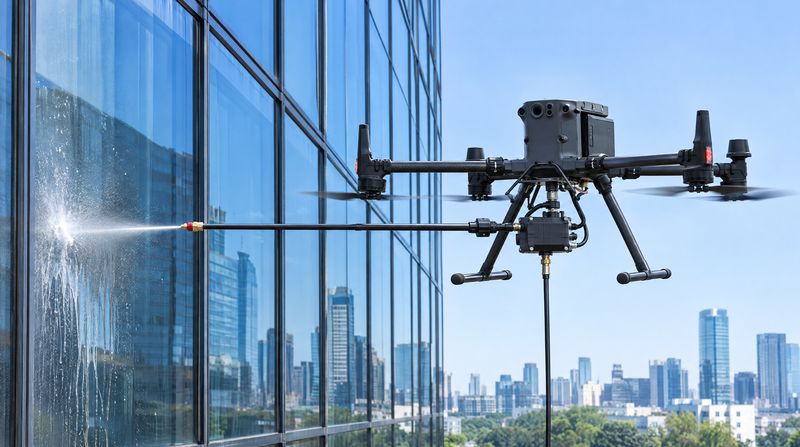
Drone-assisted washing of exterior surfaces from a ground-based water and cleaning-agent system, sequenced around tenants and operating hours, after a surface assessment and test area.
A drone reaches elevated surfaces without scaffolding, swing stages or lifts, so access setup becomes a smaller part of the job.
Scheduled cycles keep appearance consistent through the year instead of restoring it after it has slipped.
Glass is the first thing people see, and access-heavy cleaning is a recurring cost that is hard to shrink.
Drone-assisted cleaning of glazing and curtain wall with controlled water delivery, where the building and conditions allow.
Where conditions allow, drone delivery reduces the amount of work done by people on suspended access equipment.
A fixed cycle gives you predictable appearance and a predictable line in the maintenance budget.
Finish damage turns a cleaning budget into a repair budget.
Surface-specific cleaning of cladding and exterior walls, with the method approved on a test area first.
Aerial access reaches walls that are impractical to clean routinely, and unsuitable surfaces are identified before any work starts.
Repeat visits build a record of how each surface responds, so methods improve with each cycle.
Retained water and unnoticed wear shorten roof life and complicate warranty and replacement planning.
Roof cleaning on surfaces assessed as suitable. Roofs that are not suitable, or where the manufacturer prohibits cleaning, are identified before any work starts.
Aerial assessment and delivery limit foot traffic on sensitive roof surfaces.
Cleaning and condition capture on one visit means every cycle also updates your roof record.
Soiling can reduce output, and arrays are awkward and hazardous to clean by hand.
Drone-assisted array cleaning where the module manufacturer approves it, following their cleaning requirements. Thermographic screening of the same array can be scheduled in the same program.
Aerial reach covers large or elevated arrays without crews walking on them.
Seasonal cycles can be matched to local soiling patterns and your maintenance calendar.
Thermal and visual diagnostics that show where a building is holding water or losing heat, reported in a form you can act on.
Hidden roof defects drive repair cost, energy loss and tenant disruption, and replacement planning needs evidence.
Thermal and visual survey of the whole roof, with anomalies located, mapped and prioritized for follow-up.
Thermal imaging covers a large roof quickly without foot traffic, when weather and timing suit. Screening shows where to look; confirmation is by core sampling or specialist investigation.
Annual repeats under comparable conditions separate persistent problems from one-off readings.
Finding wet areas early limits the repair to the affected zone instead of the whole roof.
Targeted thermal screening for moisture-related anomalies, timed for suitable thermal conditions, with suspect zones marked for confirmation.
Aerial thermal coverage finds the zones worth sampling, so confirmation by core sampling or a moisture survey is focused.
Screening before and after a repair shows whether the repair worked.
Envelope problems raise energy cost and cause hidden damage and comfort complaints.
Close-range thermal and visual survey of every elevation, with anomalies annotated and organized for maintenance planning. It is a screening of the exterior, not an energy audit.
Full-height coverage without access equipment gives a consistent, repeatable record.
A dated baseline makes each later assessment more valuable than the last.
Façade defects are a safety and liability issue as well as a maintenance one, and early documentation supports planning.
Close-range visual investigation of façades from the air, with defects located, photographed and registered by elevation. It supports, and does not replace, any inspection that must be carried out by a qualified engineer or architect.
Aerial access shows every elevation at close range without swing stages or lifts.
Repeat investigations show whether defects are growing.
Undetected module faults reduce output and can become safety and warranty issues.
Thermographic screening of arrays at suitable sun and wind conditions, with anomalies located and logged.
Aerial thermal coverage reaches large or elevated arrays without crews walking on them.
Seasonal cycles track anomalies over time and confirm whether repairs worked.
Insurance timelines, tenant safety and repair priorities all depend on early, documented facts.
Rapid aerial documentation of roofs, façades and site conditions, organized for insurers, adjusters and contractors. It records observed conditions; it is not an adjuster determination.
A fast overview without sending people onto damaged roofs.
A pre-event baseline from a care program makes post-event comparison far clearer.
Without a clear report and a history, findings are lost between visits and priorities are argued from memory.
Annotated findings, condition comparison between visits and a ranked maintenance list, drafted with AI assistance and reviewed by an expert before delivery.
The same method at every visit, with the evidence behind each finding kept together, makes reports traceable and comparable.
Each visit extends the history, so reports become more useful over time.
Recurring programs that combine inspection, cleaning, documentation and monitoring under one scoped agreement.
Without comparable data, capital tends to follow complaints rather than condition.
A repeatable program of cleaning, inspection and reporting across your properties, on a schedule set per building.
Identical methods at every site produce records that can be ranked side by side.
Each cycle refreshes the register so planning always starts from current data.
Fragmented service means gaps, repeated mobilizations and no single record of the asset.
One annual agreement that combines exterior cleaning, thermal and visual inspection, documentation and monitoring, scoped to your building or portfolio.
One service relationship covers maintenance and condition intelligence using the same aerial approach.
Agreements renew against a scope that sharpens as the record builds.
Asset intelligence
Select a zone to see how cleaning, diagnostics and monitoring apply to it. Cleaning is scoped after a suitability assessment and test area.
Illustrative diagram. It shows where services apply, not measured site data.
Thermal screening shows where to investigate. Confirmation is by core sampling or a specialist.
Screening needs suitable sun and low wind. Repairs stay with your solar provider.
Visual and thermal screening only. Equipment servicing stays with your mechanical contractor.
A pre-event baseline makes post-storm comparison clearer.
Coatings and seals are checked first, with a test area before full work.
The wrong method can mark a finish, so materials are assessed before any work.
Programs are scoped to your assets. No savings are promised.
Programs
One agreement, four repeating steps. Each visit cleans the building, records its condition and feeds the next plan.
Thermal and visual baseline of roofs, envelopes and arrays.
Exterior surfaces cleaned to the agreed plan.
Annotated findings, evidence and condition history in one record.
Repeat visits compared with the baseline, and priorities re-ranked.
AI-assisted reporting
An AI-assisted assessment and reporting workflow. It helps our analysts find, annotate and compare conditions across visits, so you receive decision-ready reports instead of folders of images.
Findings are reviewed by a person before they reach you. Reports document observed conditions and support maintenance decisions. They are not engineering certifications.
Managing industrial facilities as well? Tanks, stacks, ultrasonic thickness, confined-space inspection and gas detection are on the Industrial page. Industrial Asset Intelligence & Services
A simple path from first conversation to ongoing service.
We review your property, site or fields and define a scope you can approve.
Access, timing, weather limits and site rules are agreed before anyone mobilizes.
The work is carried out and documented as it happens.
You receive a clear record, and recurring work is scheduled against it.
Signature services
Each signature service states who it is for, what you receive and how it is priced. Use the estimator for an indicative figure, or ask for a tailored estimate.
Property owners, REITs, facility and property managers
Condition knowledge is scattered, out of date or limited to what can be seen from the ground.
Asset Health™ Baseline · Asset Health™ Monitor · Asset Health™ Portfolio
From CAD 2,995per property, starting from. Indicative; rate pending confirmation for 2027.
Scope: Roof and envelope visual and thermal capture (as scoped); Reviewed findings with locations; Priority list for maintenance planning.
Not included: Engineering certification or structural sign-off; Repairs; Interior inspection unless scoped.
Conditions: Weather, airspace and site permissions govern scheduling; Thermal findings indicate where to investigate; confirmation is by core sampling or a specialist.
Owners and managers of flat and low-slope commercial roofs
Roof problems are found after a leak, when repair is already expensive.
From CAD 2,49525,001 to 75,000 sq ft. Indicative; rate pending confirmation for 2027.
Scope: Visual and thermal capture of the roof area; Reviewed anomaly locations; Moisture screening indicators where conditions allow.
Not included: Core sampling and repairs; Warranty or insurance determinations.
Conditions: Thermal moisture screening needs suitable weather (dry roof, adequate temperature difference); Thermal imagery alone is not presented as proof of trapped moisture.
Owners and managers of glazed, clad or masonry facades
Facade cleaning by rope access, lifts or scaffold is slow, disruptive and costly to set up.
Tailored estimateper facade area, access and surface condition.
Scope: Drone-assisted exterior cleaning of agreed facade areas; Pre-clean condition photographs; Post-clean record.
Not included: Repairs, sealing or restoration; Interior glazing.
Conditions: Subject to authorizations, insurance and the validated cleaning system (capability gate G1 and G2); Runoff handling and cleaning agents agreed per site; Wind and temperature limits apply.
Owners and operators of rooftop and ground-mount solar arrays
Defective modules and connections lose output quietly until a manual check finds them.
From CAD 2,995up to 5 MWs, then CAD 650 per MW. Indicative; rate pending confirmation for 2027.
Scope: Thermographic and visual capture of the array; Reviewed anomaly classification.
Not included: Electrical repairs or module replacement; Performance guarantees.
Conditions: Irradiance and weather conditions required for valid thermography; Site safety and access rules of the operator apply.
Owners and managers planning envelope or energy work
Heat loss and envelope defects are invisible from the ground.
From CAD 2,99525,001 to 75,000 sq ft. Indicative; rate pending confirmation for 2027.
Scope: Thermal and visual capture of the building envelope; Reviewed anomaly locations.
Not included: Energy modelling or certification; Destructive investigation.
Conditions: Needs a sufficient inside-outside temperature difference.
Inquiry
Tell us about the building and what you need to maintain or know. We will scope an assessment you can approve before anything is committed.
Prefer to talk? Call Canada +1 647 822 2946 WhatsApp Trinidad and Tobago +1 868 753 2946 Intelligence@cropcopters.com